Three strategies for designing an e-procurement system: Lessons learned in Nuevo León, Mexico

Digitalizing the public procurement cycle can be transformative: it reduces transaction costs, enhances competition, and opens opportunities for inclusion, particularly for small businesses. Evidence suggests that electronic government procurement (e-GP) systems can generate average savings of approximately 6.75% in procurement spending. However, these potential gains do not guarantee that digital transformations will always succeed. It is common to see platforms that fail to be adopted, are incompatible with established processes, or simply “digitalize paper” without simplifying the underlying tasks. Large-scale technology projects often fall into a recurring pattern: cost overruns, delays, and lower-than-expected benefits.
In Mexico, where 70% of public procurement occurs at the subnational level, effective e-GP systems are central to ensuring transparency and effective spending. Nevertheless, nearly 30% of states lack an electronic system to execute their purchases, and many that do have one operate with limited functionality. While more state governments have begun digitalizing, showing an increase of about 14% between 2021 and 2023, the challenge remains doing it right.
In this context, Nuevo León’s Ministry of Administration (Secretaría de Administración) led a reform to elevate public procurement to a more strategic level. They understood that achieving effective digitalization required ensuring the design responded to their specific functional needs and the actual options available in the market. Nuevo León’s experience offers a practical roadmap for other jurisdictions looking to move beyond paper-based procurement.
With an economy exceeding US$100 billion, Nuevo León is one of the largest and most dynamic state economies in the country, contributing about 7.6% of the national GDP, driven by strong manufacturing and exports linked to its proximity to the United States. Public procurement is a major government function, with annual expenditures of over $500 million across goods, services, and infrastructure, and processing tens of thousands of purchase orders for nearly 200 agencies.
While the state already has some digital tools to manage expenditures, the existing technological infrastructure faces limitations given the scale and complexity of public procurement operations. The Electronic Public Procurement System (SECOP) primarily focuses on publishing opportunities and requesting quotes, omitting a substantial part of the process: bid reception, evaluation, and contract award. Furthermore, planning and subsequent contract management are handled through the state government’s central accounting and financial system, which is not a dedicated task-management system for public procurement.
This fragmented configuration makes it difficult to achieve full traceability, comparable data, and end-to-end process monitoring. Likewise, partial information availability reduces the potential to strengthen competition and identify opportunities for efficiency and savings. Nuevo León’s experience also highlights a recurring challenge in public sector digitalization: when technological platforms lack flexibility, the adjustments needed to align them with day-to-day procurement operations tend to be complex and costly. This limits the government’s ability to gradually improve and adapt the system to new needs.
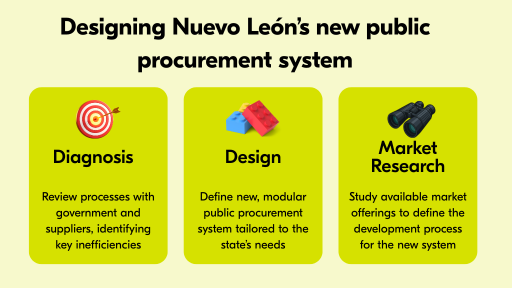
With technical support from the Open Contracting Partnership, the Ministry of Administration deployed a phased digital transformation process, beginning with a deep diagnosis, opting for a data-driven functional design, and targeted engagement with the technology market. The goal of these three strategies was to avoid purchasing or developing software before understanding the system’s functional needs and market realities.
“The transformation of public procurement did not arise from improvisation but from a technical, participatory, and collaborative process. OCP’s functional analysis helped us identify structural gaps, including the lack of a governing body, without which it is impossible to align policies, professionalize staff, and, above all, generate institutional synergies,” said Gloria Morales, Secretary of Administration of Nuevo León.
Below, we detail the three fundamental stages of this project – diagnosis, proposal, and market engagement – to guide other organizations through similar processes.
1. Conduct a deep and collaborative diagnosis
The first step for any digital reform is to understand the status quo of internal operations through the voices of those who operate them. Working with the government of Nuevo León team, OCP mapped processes as they actually happened, rather than how they were described in manuals. This methodology is key to optimizing processes, generating savings, and reforming systems. The objective was to identify bottlenecks, inefficiencies, and system failures, as well as the lack of digitalization and standardization.
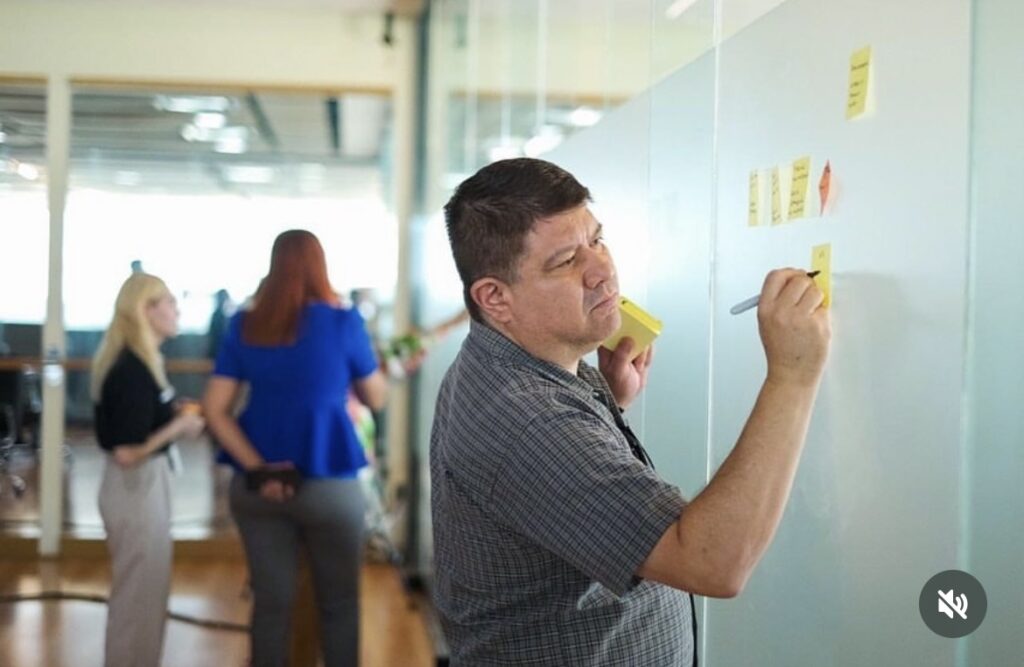
- Mapping processes step-by-step: We conducted in-person workshops with operational teams within the government and with suppliers, using visual methods (such as wall-mounted flowcharts with sticky notes) to break down every stage of the procurement cycle.
- Involving operational staff: We worked directly with those who use the system daily to identify redundant or “painful” steps. We discovered, for example, that a lack of communication between teams within the same department created bottlenecks that had never been verbalized before.
- Identifying technical and operational “debt”: We documented systematic inefficiencies caused by technical limitations and resulting workarounds, such as the need to manually generate payment orders for an annual contract, simply because the legacy system allowed no other way to manage them.
- Prioritizing problems: After completing the maps, we used voting exercises with stickers so users could point out the most critical “pain points,” thereby prioritizing what to solve first.
- The external user perspective (suppliers): We also invited suppliers to the design table. By meeting with them, we identified burdensome requirements that often prevented them from participating in procurement processes. For example, the supplier registry required companies to record a video tour of all their facilities (including private rooms if their fiscal address was also their home) to verify their existence and avoid shell companies. This requirement, besides being invasive, presented technical upload issues due to file size, disincentivizing participation from legitimate companies.
2. Design with an emphasis on functionality and data, rather than technological solutions
Once the problem was understood, we defined how the procurement process should function in a digital environment. The goal was to create workflows that eliminated detected inefficiencies, prioritizing simplification, maximum transparency, and the implementation of international best practices, such as rigorous budget planning and open opportunities.
- Functional architecture: Instead of jumping into programming, we acted as architects designing blueprints for a house, defining optimized workflows that eliminated redundancies, activated communication between areas, and incorporated “safeguards” to limit inefficiencies and bottlenecks.
- Modular structure: Modularity is the design of a system as a set of small, independent pieces (modules) with clear interfaces, allowing parts to be built, tested, and replaced without rebuilding the entire system. Opting for modularity in an e-GP system reduces risk and costs, allows for faster iteration, and avoids “vendor lock-in” or being trapped in a rigid platform. Therefore, we designed the system in critical operational modules: annual programming, planning (tender preparation and market research), bidding, contracting, execution, consolidations, supplier registry, administration, and a public site.
- Alignment with OCDS: We ensured the new design complied with the Open Contracting Data Standard (OCDS) from its inception, guaranteeing that information would be public and structured by design, rather than an afterthought. Previous experiences, such as the pre-bidding (prebases) module in Mexico City, were taken into account.
- Structure and role adjustment: As part of the design, we proposed restructuring the team and responsibilities across areas to align them with the new workflows.
The result was a set of functional requirements that translates the already optimized workflows into concrete functionalities, organized by modules and with common cross-functional capabilities, making it easy to identify what is critical at each stage without being tied to a specific technology. This modular structure allows for phased implementation, prioritizing the essentials first and leaving the rest ready for future iterations, with a shared understanding among operational, technical, and decision-making teams. Once drafted, the requirements were reviewed in detail with the government team to reach a final consensus and provide a central input for market dialogue.
What do functional requirements include (and what are they for)?
This document is the “design basis” for Nuevo León’s new electronic public procurement system. It defines the essential functionalities for achieving comprehensive digitization, facilitating the participation of internal users and suppliers, and ensuring transparency and efficiency throughout the procurement cycle. It serves as a guide to align all teams involved in the subsequent design and development phases, fostering a shared understanding of the system’s capabilities. Non-functional requirements (such as security and performance) are addressed later.
The functional requirements document follows an actionable structure:
- Clear product vision: Proposes a comprehensive, modular, and fully transactional system that digitalizes procurement methods and adopts OCDS data principles.
- Concrete modular architecture: Defines the minimum modules and explicitly applies the “open by default” principle.
- Operational governance: Includes a user manager with profiles, permissions, and electronic signature authorization levels.
- Easy multi-layer reading: Organizes requirements into general (cross-cutting), standardized (common to several modules), and specific (by module).
- Implementation roadmap: Places the deliverable as part of a roadmap including preparation, development, training, piloting, and launch phases.
3. Engage with the market to achieve the best proposal
The final phase focused on implementation strategy and market research. We sought to ensure the Government of Nuevo León could make the best decision to procure or develop the new system.
A common mistake is launching a tender without knowing what the market actually offers. In Nuevo León, we implemented a Request for Information (RFI) phase before opening the purchasing process. In the RFI, we prepared some strategic inputs to guide suppliers on the government’s specific priorities and needs:
- Prioritization and classification of requirements: Faced with over 400 functional requirements, we classified each as “Essential,” “Desirable,” or “Optional.” This allowed suppliers to understand what was negotiable.
- Module prioritization: We determined which modules were most urgent to ensure a clear roadmap for a phased implementation should budget or operational constraints require it. For example, the top priorities were the Bidding module (because everything was done on paper) and the Supplier Registration module (due to operational problems with the existing system).
With this input, the suppliers could design proposals and implementation strategies aligned with Nuevo León’s real needs and operational capabilities. Furthermore, demonstration sessions of the proposed solutions were included, allowing the state to establish better relationships with the market and have more information to make informed decisions. This was crucial to verify whether their solutions were truly adaptable to the complex processes of government or merely a sales pitch.
As a result, we helped Nuevo León reach this point with a clear vision of what type of technological solution it needs, what the market offers, and what the most appropriate strategy is for implementing the system. Now, the government is prepared to define its contracting method and move toward implementation with less risk and greater technical and budgetary certainty.
The success of this phase relied on strategic alliances such as the collaboration with Consejo Nuevo León, a muti-stakeholder policymaking body, which was fundamental in securing the political will and the necessary budget allocation for 2026, guaranteeing the project’s long-term financial viability.
Finally, the experience of Nuevo León shows the digital transformation of public procurement must begin with a deep understanding of the processes, the people, and the market, and not necessarily with the purchase of technology.
Diagnosing before digitizing allowed the state to reduce the risk of contracting platforms that don’t solve the root problems or that perpetuate dependencies on pre-existing suppliers, laying the foundation for a successful implementation.