Democracy’s procurement problem: Breaking the pay-to-play cycle through coordinated oversight

In May 2024, we sent letters to more than 800 mayors in Colombia, reminding them of the law: large campaign donors cannot receive public contracts from the administrations they helped elect. Some letters arrived alone. Others were copied to investigative journalists or to Colombia’s Inspector General. Some came with a list of every donor to the mayor’s campaign, cross-referenced with the contracts those donors had already won.
Over the next nine months, only one version of the letter made a difference. In municipalities where the letter came with the donor list and a copy went to the Inspector General, donors were roughly 30% less likely to receive contracts. No other combination moved the needle.
The finding comes from a nationwide randomized controlled trial that OCP helped design and implement in partnership with Colombia’s Inspector General’s Office (Procuraduría General de la Nación), the non-profit Instituto Anticorrupción, investigative journalists, and researchers from Georgetown University, the University of Notre Dame, and Stockholm University.
Voters in many countries complain about money in politics. We can study the problem in Colombia because the data exists, but the basic pattern is familiar around the world. A person or company funds a politician’s election campaign. Once in office, the politician steers lucrative public contracts to donors, their businesses and their associates. When that becomes routine, government contracting stops being a tool for delivering public services and becomes a way to reward political allies. The same people stay in power, election after election, financed by the contracts they award. The schools, clinics, and roads paid for with public money arrive late, cost more, or never arrive at all.
All governments are vulnerable to these dynamics, which are hard to measure and harder to manage. Until recently, we had little empirical evidence about what works.
Campaign donations deliver a high return on investment
In Colombia, two public systems – SECOP for procurement and Cuentas Claras for campaign finance – give researchers and the public a remarkably complete view of who gets paid and who pays for campaigns. Few countries in the region have this combination, and OCP and local civil society organizations have spent years working with Colombian institutions to keep that data infrastructure open and usable.
The scale of public procurement is enormous. In Colombia, government contracting accounted for roughly 200 trillion pesos in 2025 (about US$50 billion). Around 70% of that spending happens at the subnational level, in departments and municipalities where mayors and governors hold substantial discretion over who gets contracts. Indeed, non-competitive procedures are used for 81% of all municipal contracts.
The researchers linked about 7 million municipal contracts signed between 2012 and 2024 with mandatory campaign donation reports across three election cycles. The emerging pattern is striking and consistent. After elections, people and firms who donated to mayoral campaigns were on average 28% more likely to win contracts than non-donors, and the contracts they won were worth 17% more. Those contracts also performed worse, being 5% more likely to report cost overruns. On average, those overruns were also 9% larger.
And the advantage outlasts the mayor. Donors keep winning a disproportionate share of contracts for up to eight years after the election they paid into.
The authors’ analysis suggests at least three-quarters of a billion dollars in subnational contracts flow to political donors in Colombia each year. The real figure is almost certainly higher. Colombia’s political finance system has well-documented underreporting, and donors who never appear in official records are classified as non-donors in the data.
Enforcing electoral law with actionable data
Private campaign contributions are a legal part of Colombian political life. The aim of our research was not to change the rules, but to ensure the existing ones can be enforced, and that everyone in the system, mayors, oversight bodies, and the public, has the information they need to act on it.
The Colombian electoral law clearly states that anyone who contributes more than 2% of a candidate’s spending limit cannot then receive contracts from that candidate’s administration. Other restrictions apply to public contractors who donate, to family members of donors, and to firms with disciplinary sanctions.
Yet, enforcement remains weak. Part of the reason is sheer scale. Colombian municipalities sign hundreds of thousands of contracts every year. No oversight body, however well-resourced, can review them all. The only practical path to real enforcement is to use data to prioritize: cross-reference donations with contracts, surface the cases where the rules most likely apply, and put that information in front of the people who can act on it. That was the design principle behind our intervention.
Six months after they took office, we sent letters to the new mayors of 876 municipalities. Every letter reminded them of the legal restrictions on awarding contracts to their campaign donors, and every letter carried the logos of OCP and the Instituto Anticorrupción. What varied was who else was on the letter and what came attached.
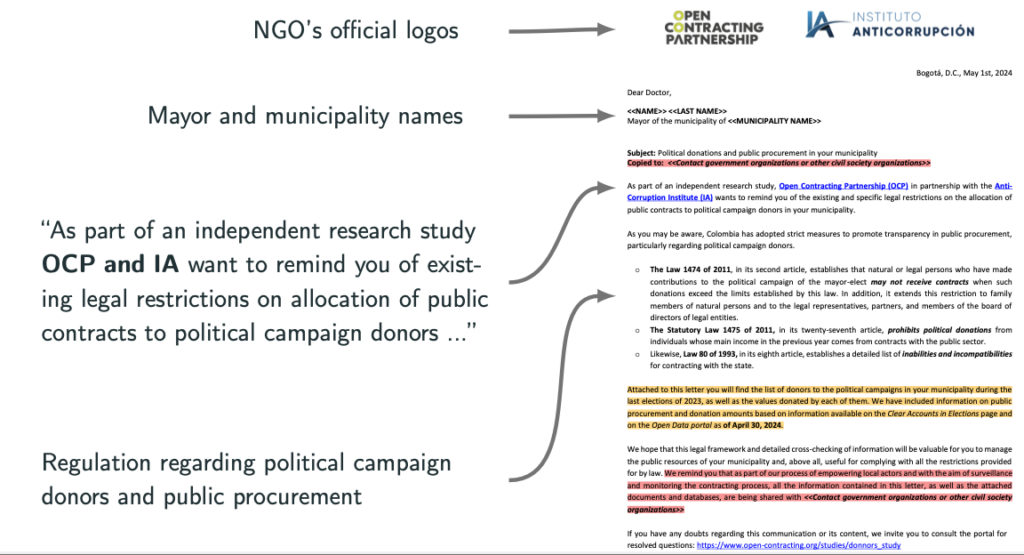

Some mayors received only the letter. Others received it copied to investigative journalists. Others received it copied to the Inspector General’s Office. Within each of those groups, some letters arrived with an attachment: some received a list of every donor to the recent mayoral campaigns in that municipality, cross-referenced with the contracts those donors had already received; while others received a partial list. The donor list was built entirely from public data drawn from SECOP and Cuentas Claras.
We then tracked every municipal contract signed over the next nine months and compared what happened in each treatment arm against a control group that received nothing.
Coordinated oversight changes how mayors behave
Only one combination worked. Mayors whose letter named the Inspector General’s Office as a recipient and included the full donor list were around 30% less likely to award contracts to campaign contributors than those in the control group. The value of contracts to donors in those observed municipalities was also 4.3% lower. Cost overruns on donor contracts also cost 6% less. Effects held for the full nine months we tracked.
On the other hand, the letters that only reminded mayors of the law, or that failed to include the Inspector General’s Office, didn’t result in any changes. Mayors changed their behavior only when an authority that could plausibly sanction them was paired with information specific enough to act on.
The researchers call this “credible oversight”. At OCP, we have been seeing the same pattern across our work in different countries. Reform coalitions only move the needle when there is coordinated action between actors inside and outside government, each contributing what only they can. In this case, civil society, OCP, and the Instituto Anticorrupción, brought the data, the cross-referencing, and the public-facing legitimacy of an independent reminder. The Inspector General’s Office brought the legal authority that made the threat real. Neither approach worked alone. With both, millions of dollars in contracts shifted away from politically connected suppliers in under a year, at a fraction of the cost of an audit.
Beyond nudges: building enduring oversight systems
Colombia needs wider political financing reform. The country’s political system has structural weaknesses: not enough public financing of campaigns and few tools or practices to detect and sanction illegal contributions. Colombia’s Transparency International local chapter, Transparencia por Colombia, has led a multi-year effort to make progress on these fronts. Those reforms will take time and political capital.
In the meantime, there is significant ground to be made by building systems that use the data we already have to track deviations from existing rules, while encouraging better reporting of both political financing and contract allocation. Our intervention shows that even a basic form of this approach changes behavior. A more permanent process, embedded in how oversight institutions work in practice, could change how procurement and political finance interact.
Our vision is to make coordinated oversight between the Inspector General and civil society a standing practice rather than a one-time experiment.
That means oversight that operates continuously across the political cycle:
- pre-election alerts to candidates, voters, and firms during the campaign period itself, so that expectations are set before the deals are made;
- escalating post-election enforcement when irregularities appear, ranging from procurement report requests to formal disciplinary inquiries led by control institutions; and
- data pipelines linking Cuentas Claras and SECOP built once and used every election cycle.
Civil society can’t step back once oversight institutions have the data. Our work shows civil society organizations and researchers can help build the data infrastructure while bringing independent legitimacy and the willingness to surface uncomfortable patterns. Control authorities bring the legal mandate that gives the system consequences. Neither role can absorb the other, and neither works alone. Making this approach durable means committing to sustained partnership across electoral cycles, not handing off a tool and walking away.
These political and economic distortions don’t have to be permanent features of public procurement. They persist because the actors who could push back on them tend to work in parallel rather than together. Control authorities, civil society, journalists, and researchers all want public money to reach the services it was meant to fund.
The Colombia results show what shifts when those actors coordinate around that shared outcome, and each reinforces what the others can do. Mayors change their behavior. Contracts shift. And the schools, clinics, and roads that public money was meant to deliver actually get built.


