Out of the shadows: Germany’s public procurement data under the spotlight

Germany now publishes more than a million procurement notices as open data. Transparency International Germany turned them into a red flags dashboard. Here’s what the data tells us, and what it still can’t.
How much does Germany spend on public contracts? Nobody knows for sure. The Federal Statistical Office counted €135 billion for 2024, while OECD’s estimate of total government purchasing already in 2019 exceeded €500 billion. No one knows how much of that more than €300 billion difference is contracts the public can’t see.
This matters. If we don’t know what public bodies are buying, for how much and from whom, we can’t tell whether taxpayers are getting value for money, whether competition is working, or where corruption risks sit. Transparency builds trust in public institutions: it enables democratic oversight, attracts more bidders and leads to stronger offers.
A new data source
For years, Germany lacked a centralized reporting mechanism. Since October 2020, the Procurement Statistics Ordinance (VergStatVO) has required public buyers to report to the statistics office. The result is a backward-looking PDF report, which is useful for describing the market but of little real-time value for understanding the government’s current purchasing priorities. It can’t show, for example, how the country’s unprecedented €500 billion special investment in public infrastructure over the next 12 years is playing out across cities and municipalities.
The Publication Service (Bekanntmachungsservice) is meant to close that gap. It became the official data hub and EU eSender (the official channel for sending German notices to the EU’s Tenders Electronic Daily) in October 2023, a year after its launch. Since 2024, the data has been available as open data, including in the Open Contracting Data Standard. Implemented as part of a digital and open government agenda under the previous government, the service is a major step toward increasing the visibility of procurement in Germany, providing unified, real-time data across the procurement process for the first time.
Since July 2026, buyers who submit notices to the Publication Service can skip separate reporting to the statistics office, which should improve coverage, particularly for below-threshold contracts. New features added earlier this year make the portal more user-friendly for companies, allowing interested suppliers to keep track of tenders, lots and deadlines.
The data is updated daily. It’s not yet a single source of truth (as in the UK), but has become the largest source of information on Germany’s procurement, with about 1 million notices since 2023. Over time, as the data quality and coverage continue to improve, having this structured data will make it easier for buyers, suppliers, and taxpayers to glean actionable insights. The EU’s Public Procurement Data Space already uses the data in basic dashboards on competition. More importantly, civil society can now do its own analysis – which brings us back to Transparency International Germany’s red flags dashboard.
Let’s have a look to see what the data tells us, what needs improving both in terms of reporting as well as procurement practice, and some of the red flags.
What does the data tell us?
The platform provides access to all of Germany’s procurement reporting to the European Union starting in 2023.
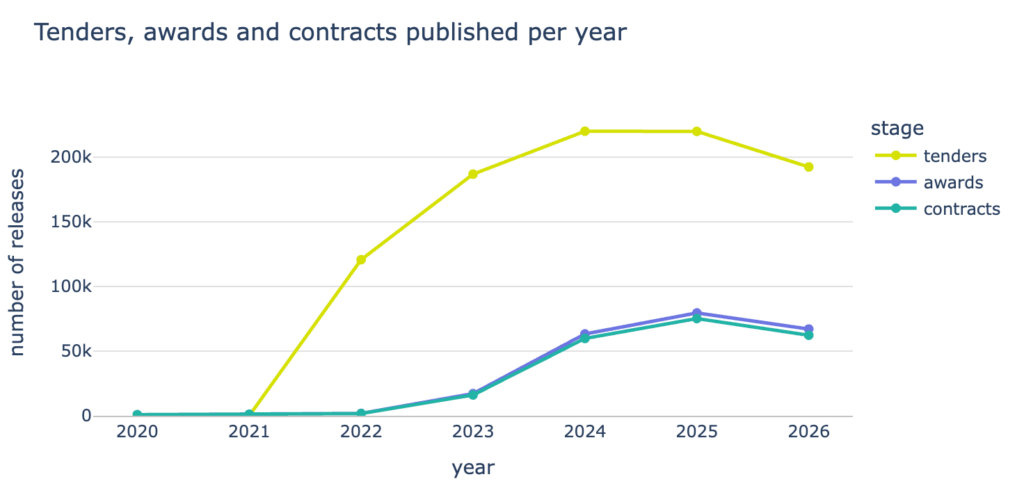
The procurement phase with the best coverage is tendering, with about 200,000 tender processes per year since 2023. In 2025, about one in three procedures also has data on awards and contracts.
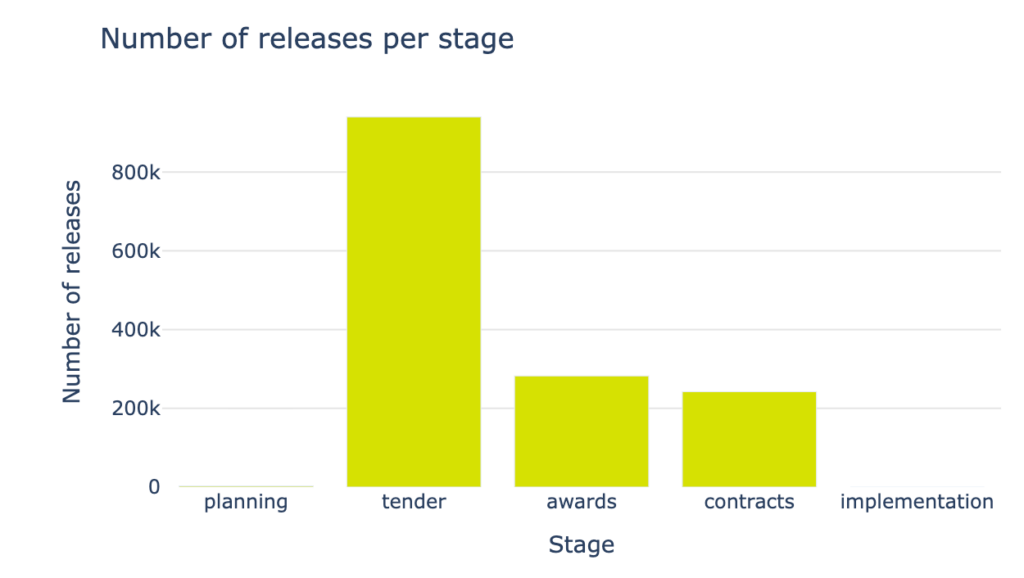
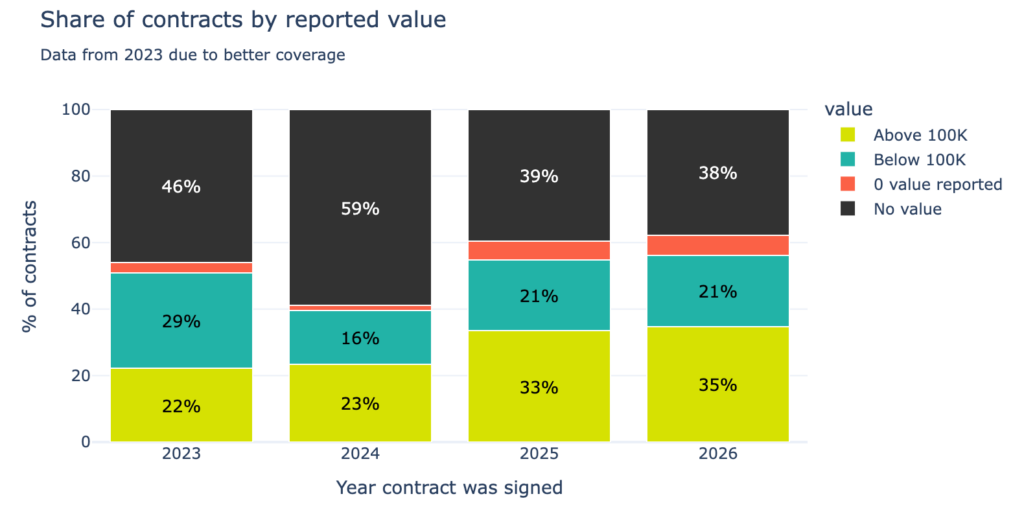
Large infrastructure dominates the dataset, which isn’t surprising given the platform’s focus on reporting above-threshold procurement to the EU (contracts below €100,000 account for only 21% of procedures). Construction work is the top sector. In 2025, the companies with the most contracts include infrastructure and rail firms (DB Engineering & Consulting and Siemens Mobility), vehicle manufacturer MAN Truck & Bus, and emergency vehicle makers Rosenbauer and Albert Ziegler.
The largest buyers reflect this focus on construction too. They include DB InfraGO, which manages Germany’s railway infrastructure, and the state building and property agencies of Saxony and Baden-Württemberg. The federal development agency GIZ is also on the list.
The good news is that, since its launch in 2023, data coverage beyond the tender stage has increased, from 8.3% in 2023 to 27.6% in 2024, 34% in 2025, and 38% in 2026 (October).
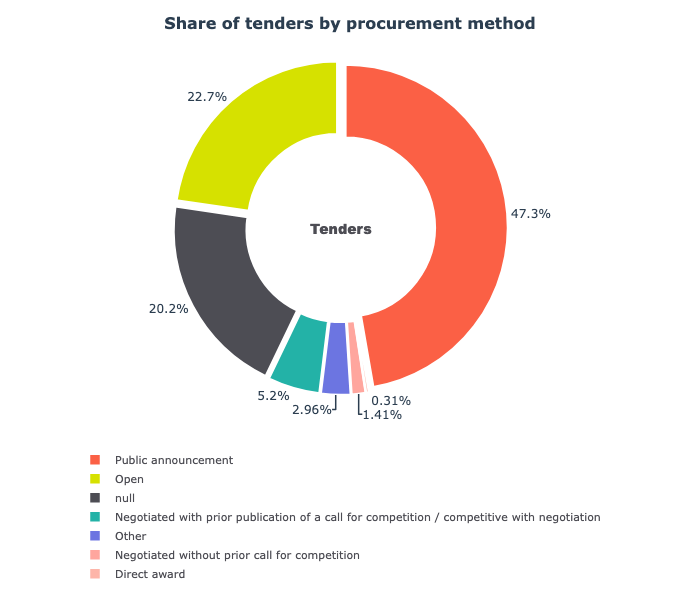
Most of the tenders on the platform use some form of competitive procedure type (open, restricted or negotiated with a call for competition). That is likely because direct awards are not proactively published, particularly those below the reporting threshold.
Overall, there are some notable limitations in the data quality.
In 2025, 39% of contracts do not publish any value and 7% publish a value of “0”. While that is an improvement on previous years, Germany’s lack of data on award or contract values stands out vis-à-vis its European peers.
Also, while official buyer IDs exist, only 29% of records use them. The country’s public procurement agency itself, the Beschaffungsamt in the Ministry of Interior, lists its procurement processes under seven different entries. A purchase category (i.e. goods, works, services) is not included in about half of all procurement processes.
A look at red flags
The platform analyzes several red flags, focusing on those that indicate restricted competition and a lack of transparency, including direct awards, single-bid contracts, and missing contract values. It also links winning suppliers to Germany’s lobby register.
It’s important to remember these insights are not representative of Germany’s entire procurement system, but only those parts captured in official reporting. Some public buyers who publish more data may appear more exposed than buyers who only share some high-level contracts (or don’t share any data).
Nearly half of the contracts didn’t include price values in 2025 (46%). This gap may widen further. The Procurement Acceleration Act (Vergabebeschleunigungsgesetz), in force since 1 July 2026, lets federal buyers award contracts of up to €50,000 directly, and makes statistical reporting optional below that value. Several states (Länder) are raising their own thresholds too, up to €100,000 for direct awards.
Publishing below-threshold contracts would fill a crucial gap in transparency, because they make up most municipal procurement. The Cartel Office’s latest annual report (p. 19), for example, describes fines issued over bid-rigging in municipal road repair contracts, most of them worth between €40,000 and €200,000. Yet only a small share of low-value contracts like these appear in the public data. Information on values is critical to prevent contract splitting as integrity risks increase for contracts just under price thresholds. Spain’s Civio has shown that pattern in municipal contracts clearly.
Single-bid contracts can indicate integrity risks or market concentration. Since 2023, the share of single-bid contracts has increased to 60.8%. However, these numbers need to be interpreted with caution, as a published single-bid contract is better than a direct award that isn’t.
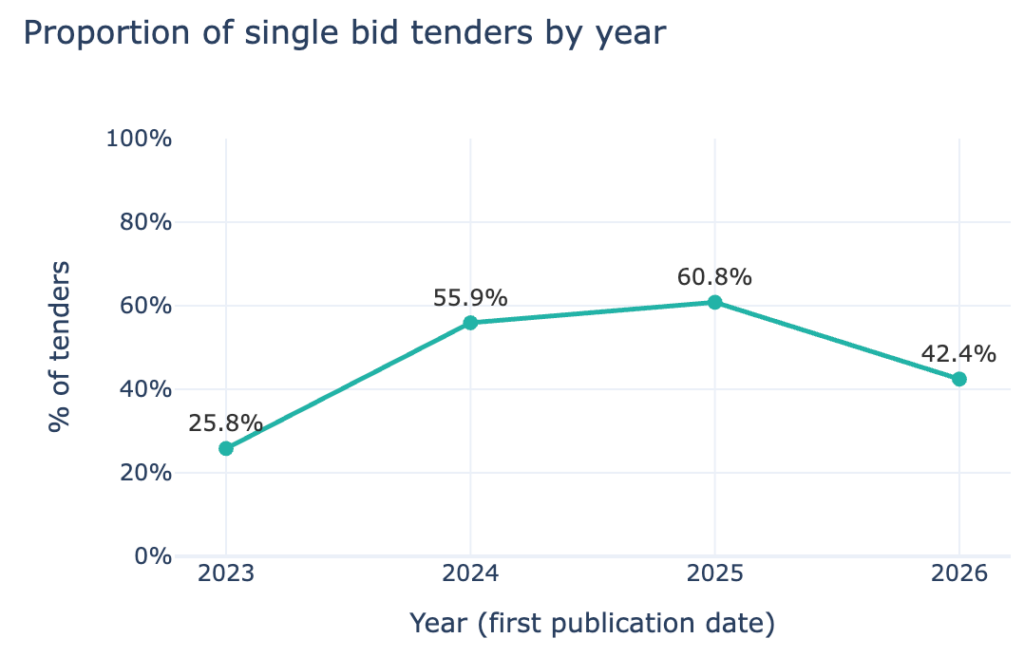
Just over 1,000 direct awards are listed in 2025, or 0.5%. This illustrates a major gap in publishing direct awards to ensure accountability.
The dashboard also lets users check companies’ past contracts. While there’s no indication of current wrongdoing, two of the top 10 suppliers, Rosenbauer and Albert Ziegler, were fined in 2011 in a cartel investigation involving fire engines.
Next steps
While more access to data is progress, without consistent data on contract values, we don’t know how much the government is paying. The current legislative reform process, which is now moving on to rules for below-threshold contracts (the UVgO) and state procurement laws, prioritizes speed over accountability. It recognizes corruption as an issue, but that recognition doesn’t translate into detailed requirements. Centralized reporting of basic data for all smaller contracts, including values, should be mandatory. This is particularly urgent as six of Germany’s 16 federal states have already raised the threshold below which contracts can be awarded without competitive tendering to €100,000.
Municipalities face projected budget deficits of around €30 billion a year, which will directly affect local infrastructure. When budgets are this tight, every euro overpaid in a rigged or uncompetitive contract is a road, swimming pool or daycare center not repaired.
We need more courage on transparency. The problems are most acute where most people experience government action firsthand. Only if we know what is bought, when, from whom, and for how much can procurement power up economic growth – especially in the cash-strapped municipalities that ultimately pay the price for weaknesses in the system.


