From plan to action: How Paraguay made its sustainable public procurement policy count

Challenge: Paraguay had built a strong foundation for integrating sustainability into public procurement, but measuring the uptake of its sustainable procurement policy remained a challenge.
Open contracting approach: OCP supported Paraguay’s public procurement agency DNCP to close the gap in tracking the implementation of sustainable public procurement (SPP). This included:
- Incorporating sustainability clauses into the electronic government procurement (e-GP) system and capturing structured data in standard bidding documents.
- Automating the measurement of sustainability clauses in an internal dashboard using key indicators to establish baselines and track uptake of all clauses
- Identifying key product and service categories where applying SPP criteria is likely to have the biggest impact on social, economic and environmental outcomes.
Results: DNCP can measure the uptake of its SPP policy with sustainability clauses, using structured data from the e-GP system. Indicators on the dashboard are now being used by internal users. More than 10,000 sustainability clauses were identified in tenders awarded over a two-year period (for context, DNCP publishes roughly 9,000 tenders per annum). Mandatory and preferred SPP criteria have been defined for five priority products and services.
Across Latin America, many countries are integrating sustainable procurement into their legal and institutional frameworks, as public procurement is recognized as a powerful lever for advancing broader policy goals – from environmental sustainability to the inclusion of small businesses.
Yet translating policy into practice remains a defining challenge, due to limited technical capacity, lack of policy guidance, reputational risks, and a tendency to prioritize short-term efficiency over long-term goals. This leads many procurement systems into a trap: a stage where policies are drafted and indicators identified, but implementation stalls and results go unmeasured.
Paraguay offers a model of how countries might work their way out. Its sustainable procurement framework is among the more comprehensive in the region. Important pillars introduced in recent years include:
- a Sustainable Procurement Policy (2020), which established a triple bottom line approach, embedding social, economic, and environmental dimensions across the procurement system;
- an implementation plan, which defined concrete levels and targets, mapped out corresponding actions, and created a dedicated sustainability committee drawing on expertise from key institutional areas;
- a new procurement law (Ley N° 7021/2022), which moved beyond price-only evaluation to incorporate sustainability criteria, whole life-cycle costing, priority for local and family farming, and procurement clauses spanning all three sustainability dimensions;
- a new supplier registry (2024) capturing sustainability information from suppliers, complemented by HAPS – a self-assessment platform that evaluates a company’s capacity to supply sustainable goods and services; and
- the Higher Technical Institute for Public Procurement, an educational institution run by DNCP that provides buyers and suppliers with the practical knowledge needed to implement sustainable procurement measures.
Despite this strong foundation, there was no systematic mechanism to measure whether the sustainable procurement policy was actually being implemented or producing results.
DNCP partnered with OCP on a project focused on closing that gap, overcoming what we’ve come to call the “valley of death” in sustainable procurement, borrowing a term from the world of startups. We took a phased approach that involved multistakeholder collaboration, improving data collection and developing digital tools. Through continuous technical assistance and hands-on sessions, we worked alongside DNCP to embed the sustainable procurement policy in practices and track the results with data.
Incorporating sustainable clauses into the e-GP
The first step towards measuring sustainable procurement was to define sustainability clauses. Clauses are rules in tender documents that suppliers must follow. They set out the conditions a supplier needs to meet throughout the procurement process—whether to bid, carry out the contract, or receive payment. For example, a clause might require the supplier to source at least 10% of its materials from family farming or to adhere to specific environmental standards during project execution. These clauses are typically mandatory (subject to a pass/fail assessment), and compliance is verified during contract execution rather than during the bid evaluation stage.
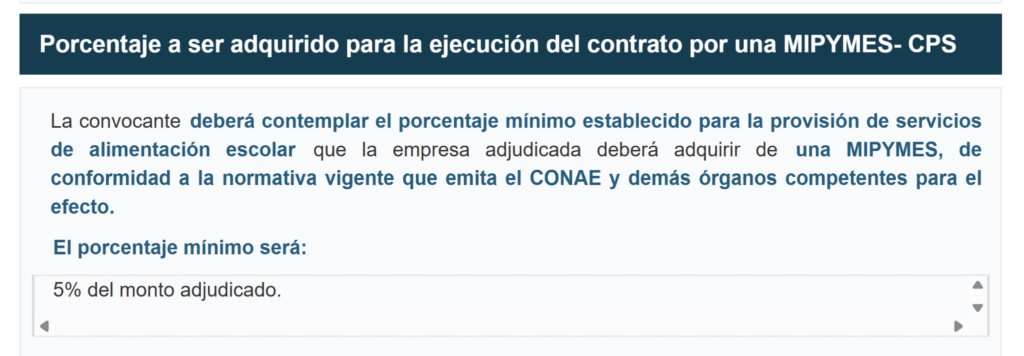
We worked with DNCP’s sustainability committee to conduct a review of all standard tender documents and compiled clauses contributing to any dimension of sustainability, with each clause categorized as environmental, economic, or social. Paraguay had already established these standards through regulations, but they hadn’t yet been integrated into the e-GP system. We first compiled and categorized clauses with cross-cutting impact (e.g., the number of bid copies required), followed by those related to a specific sector (e.g., accessibility standards and criteria for construction works).
The table below outlines the sustainability clauses we compiled and the measurable indicators for tracking them on DNCP’s internal dashboard.
| Category | Clause type | Description | Dashboard indicators | No. of tenders with clause (02/24–03/26) |
|---|---|---|---|---|
| Social | Accessibility standards | Conditions that State works must meet to be accessible and usable by all people, including persons with disabilities. | Technical standards and criteria for accessibility to the physical environment | 2 |
| Family farming sourcing | At least 10% of products in food procurement must be sourced from producers registered under the Family Farming category. | Percentage to be sourced from family farming | 49 | |
| Mandatory declaration of contractor personnel in SICP | Suppliers must register subcontractor and personnel data in the e-GP system within 30 days of obtaining the contract. | Obligation to declare contractor staff information in the SICP | 2 | |
| Additional payments for security and surveillance personnel | Covers family allowances, hazard bonuses, productivity bonuses, and other payments under current regulations. (Applicable to security and surveillance processes.) | Other additional concepts to be paid | 70 | |
| Minimum payment concepts for security and surveillance staff | Bidders must submit a sworn payroll statement detailing all labor costs in their offer. (Applicable to security and surveillance processes.) | Minimum concepts to consider for payment to the bidder’s staff | 70 | |
| Economic | Hiring of local personnel | Applicable to school meal services, requiring a minimum percentage of locally hired staff to stimulate the local economy. | National product and employment certificate – SBE Catering | 5 |
| Hiring of local area staff | 77 | |||
| Local preference margin | A preferential margin for local suppliers under Law 7021/2022. | Local preference margin 7021 | 5 | |
| Environmental | Copies of offers | Limits physical document printing by capping required copies at 0, 1, or 2. | Copies of offers S 7021 | 9,294 |
| Environmental requirements for public works | Compliance with all environmental legislation, assessments, licenses, and permits to minimize negative impact. (Applicable to public works.) | Environmental requirements 7021 – works | 0 | |
| General sustainable public procurement clause | Covers social, economic, and environmental criteria in bidding document preparation and responsible business conduct. | Sustainable public procurement | 5 | |
| Environmental requirement | 4,106 |
The new e-GP system developed by DNCP in 2024 had the flexibility to incorporate new features as needed. This allowed DNCP to add the different sustainable clauses directly to standard bidding documents in digital form. These clauses were assigned a sustainability mark—using the acronym CPS, short for Compras Públicas Sustentables, in the electronic tender document format—for external visibility. A green badge was also added to all clauses with a sustainability component, so that the buyer could identify them intuitively.
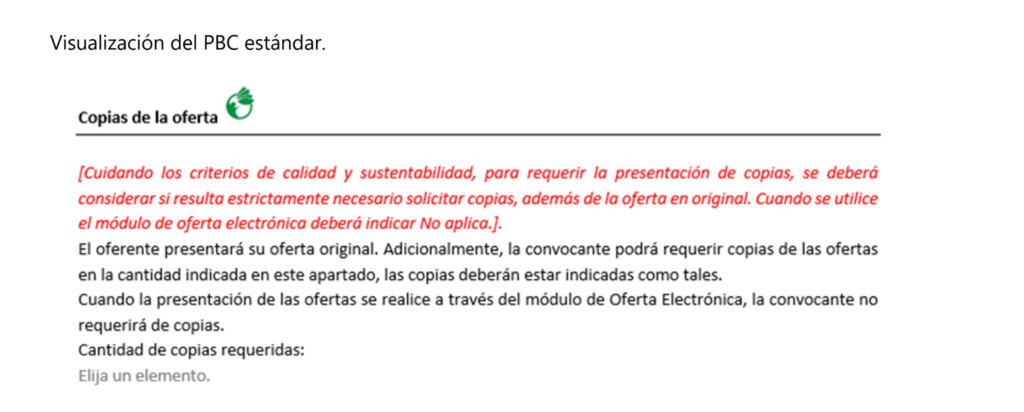
[Translation: Bearing in mind the quality and sustainability criteria, before requiring copies to be submitted, consider whether it is strictly necessary to ask for copies in addition to the original bid. Where the electronic bidding module is used, enter “Not applicable”.]The bidder shall submit its original bid. In addition, the procuring entity may require copies of the bids in the number indicated in this section; the copies must be marked as such. Where bids are submitted through the Electronic Bidding module, the procuring entity will not require copies.
Number of copies required:
Choose an item.]
Now, every time a contracting authority uses those documents, the system automatically captures structured data on which clauses have been applied, converting policy into data points. Internally, the clauses are extracted from the database, and a daily tally is performed of the procurement processes that apply them. This count tracks each published tender process that incorporates these specific clauses.
An internal dashboard for monitoring uptake of SPP clauses
After these clauses were embedded in the standard bidding documents, DNCP could query them systematically and track their use across procurement processes.
We worked with DNCP to define key indicators to measure the SPP policy through workshops focused on developing a theory of change for the initiative. These sessions covered the actions required from DNCP to advance implementation, including reviewing data fields available in the new e-GP, identifying which sustainability clauses needed to be incorporated into tenders, and defining how frequently the dashboard should be updated.
This step was critical to building trust within the DNCP team and enabling them to move forward with developing a monitoring dashboard, allowing the DNCP’s leadership to understand how sustainable procurement uptake was evolving.
An internal dashboard was developed in early 2025 to monitor the uptake of these clauses in an agile and user-friendly manner. This dashboard represents the most significant output of our intervention (see screenshot below). Metrics collected from February 2024 to March 2026 can be used as baselines to later monitor progress (see table above). As a reference, DNCP publishes roughly 9,000 tenders per year, so this means uptake is high in some clauses (copies of offers), while very low in others.
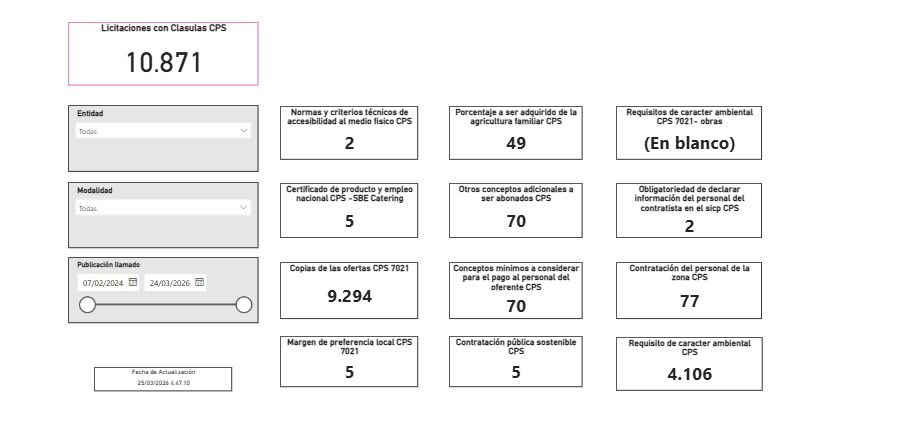
The internal dashboard is mainly used by members of the sustainable committee and by the director of DNCP, but the team and its leadership expect to make the dashboard public in the future.
Additional technical improvements would allow for more granular insights. One clause already being monitored in more detail is the clause on sourcing from family farmers as part of the school meals program Hambre Cero (Zero Hunger). While the SPP dashboard shows the overall uptake of this clause in contracting processes in a single number, more specific analysis on how this clause is implemented in practice can be tracked at the contract-level using the Open Contracting Data Standard (OCDS) data from DNCP. For instance, when measuring the uptake of the family farming clause, the number of subcontracts and value awarded to family farmers and small enterprises can also be assessed.
Defining sustainability criteria the market can meet
In addition to working on incorporating SPP clauses in the e-GP and supporting DNCP to track them in a dashboard, OCP also supported DNCP in better defining SPP criteria. Criteria are typically used during bid evaluation and are used to score or qualify bidders.
Prior to our project, DNCP had partnered with specialized technical organizations to define which sustainability requirements buyers could request from suppliers across the three dimensions (social, economic, and environmental) while also assessing the market’s capacity to meet those requirements.
Building on this foundation, DNCP made an early strategic decision to distinguish between two types of sustainability criteria: those that could be applied uniformly across all procurement (particularly social ones), and those requiring a more targeted, category-specific approach. For the latter, specific categories of goods and services needed to be selected and prioritized before any measurement could begin.
A new scoring matrix to prioritize sectors for sustainability criteria
To identify which categories to prioritize, DNCP’s new scoring matrix uses five weighted variables:
-
- Procurement volume (15%), whether the good or service is purchased in low, medium, or high volumes (i.e. quantity and value of procured items)
- Procurement frequency (15%), number of purchase orders generated, regardless of value
- Current MSME participation (20%), based on a study of micro-, small and medium-sized business enterprise (MSME) participation in public procurement (2017–2020) conducted by the Ministry of Industry and Commerce and DNCP, reflecting the opportunity to shift existing suppliers toward more sustainable models
- MSME potential (25%), based on planned procurement data, reflecting the feasibility of bringing new MSME suppliers into the public market
- Potential for applying social and/or environmental criteria (25%), the technical feasibility of requiring, verifying, and ensuring compliance with sustainability criteria within that category
Each variable is assigned a score, 1 (low), 2 (medium), or 3 (high), and the weighted scores are combined to rank categories by priority.
OCP’s role in this phase was to facilitate the process through workshops that brought together the sustainable procurement committee and experts from other ministries, as well as industry stakeholders. These sessions helped drive alignment on targets, refine the selection of product and services coding categories (using the UNSPSC classification system), and incorporate iterative improvements into the design of framework agreements.
The result was a shortlist of five priority categories:
| Goods & services category | Example of sustainability criteria defined |
| Food | Sustainable production; efficient in use of resources |
| Building maintenance and repair | Decent working conditions; use of sustainable materials |
| Textiles | Low environmental impact materials; fair production |
| Furniture and fixtures | Use of sustainable materials; recycling and reuse |
| Cleaning supplies and services | Occupational safety and well-being; substitution of harmful chemicals |
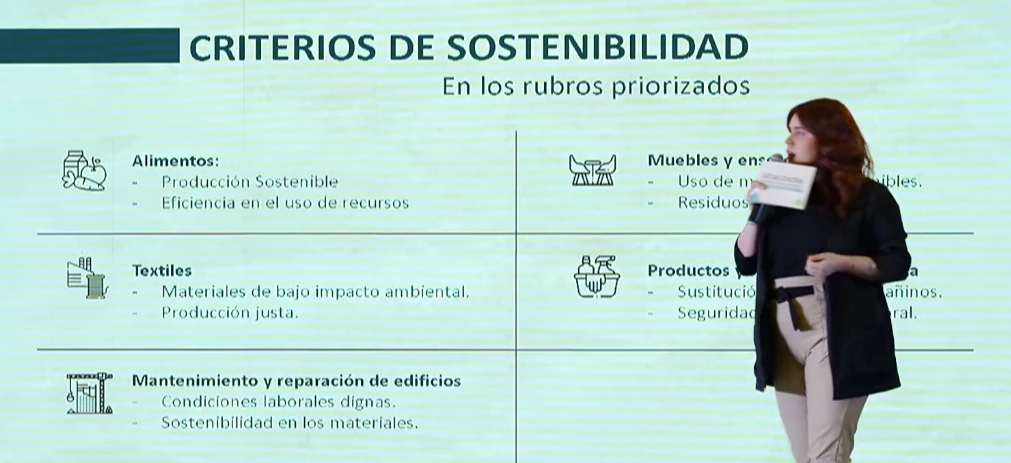
For each priority category, a set of specific sustainability criteria was defined, distinguishing between two types:
- Mandatory criteria (pass/fail): Requirements that must be met without exception. If a bidder does not comply, they may be disqualified from the tender process.
- Preferred criteria (voluntary): Criteria that are not required but are rewarded positively in the evaluation process, giving an advantage to bidders who meet them, through an objective scoring mechanism.
In both cases, the criteria were designed with the specific context of each category, the market’s capacity to respond, and the characteristics of the products or inputs involved in mind. For example:
| Name | Criteria Type | Impact Type | Sustainability Criterion | Verification / Execution Control | How to implement |
| Specific sustainability criteria for purchasing office furniture, air conditioners, and accessories | Pass/Fail | Environmental – Energy consumption | Air conditioning units must meet minimum energy efficiency standards. | Eco-labels or recognized environmental certifications, or certification from the relevant authority. | Can be incorporated immediately into tender documents. When included, add the acronym CPS next to the requirement. |
This progress is the first step towards actively applying such criteria into tenders, which has been a more complex process than operationalizing monitoring of clauses – although the legal framework grants broad discretion to procurement units to incorporate sustainability criteria in tenders.
OCP continues to advise DNCP on how to systematically measure the number of bids that comply with sustainable criteria, which can currently only be identified through free text queries.
We would also like to see more SPP data made publicly available, building on the work Paraguay has already done to publish comprehensive open contracting data in OCDS format, including information on SMEs.
Photo credit: Paraguay’s Palacio de los López illuminated in green. Doveller Channel


