From policy to practice: how Boston used data to open up contracting to small and diverse businesses

Challenge: Public contracting can be a powerful tool for local economic growth and inclusion, but in Boston many small and diverse businesses were missing out. A landmark 2020 Disparity Study commissioned by the City found that minority- and women-owned businesses (M/WBEs) received 11% of the value of Boston’s contracts over five years, despite being ready and able to compete for an estimated 16.9% of contracting dollars. Black-owned businesses faced the starkest gap, winning roughly $12 for every $100 they might have been expected to receive. Boston set out to change that: opening more opportunities to historically disadvantaged businesses while building a better way to track participation, spending and whether its reforms were working.
Open contracting approach: Boston introduced a series of reforms so its procurement practices could deliver on its policy goals: more contracting dollars earned by minority and women entrepreneurs, more local employment opportunities for residents, and a more competitive marketplace that fostered better prices for the City. Staff came together from different government units to focus on three areas:
1. Opening more routes into City contracting for small and diverse businesses;
2. strengthening cross-departmental coordination, so buyers could plan earlier and use new procurement methods consistently;
3. and improving data-driven monitoring and spending decisions to measure impact and see if their actions to boost inclusion and participation from small businesses were working.
Through our impact accelerator Lift program, Open Contracting Partnership (OCP) acted as a strategic partner in that work, helping the City sharpen its reform strategy and connect open data to its inclusion goals, including through designing key performance indicators, dashboard development and procurement forecasting.
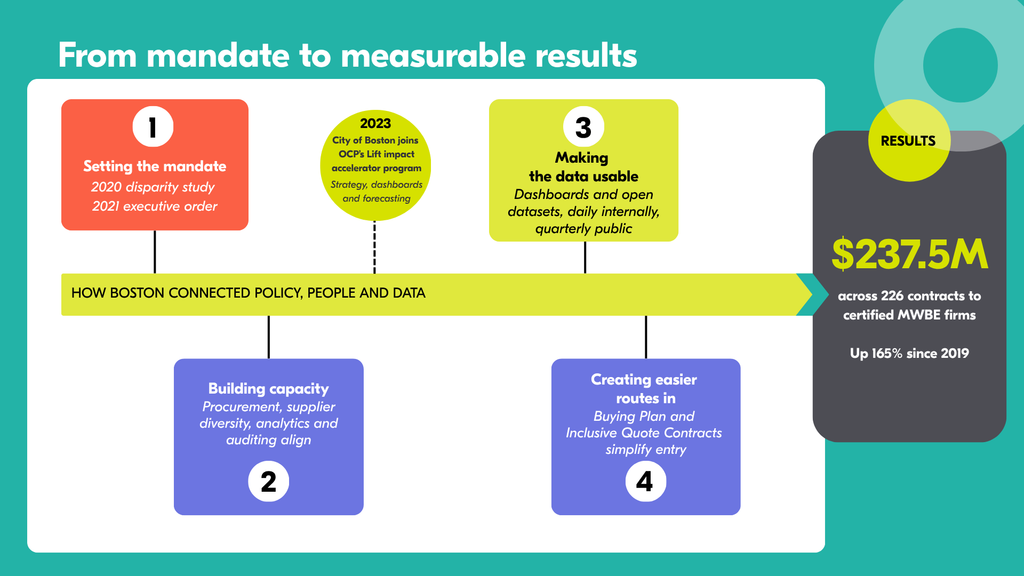
Results: Since Lift began in 2023, the value of contracts awarded to certified M/WBE firms rose by almost 50% from $160.3 million to a peak of $237.5 million in FY25. The number of contracts awarded to these businesses increased 25%, from 181 to 226 that year, and the share of ”discretionary spending» (money actually paid to suppliers, where the City has a choice of vendor) more than doubled. Looking at the full reform since FY19, the value of contracts awarded to certified firms is up 165% at its FY25 high, while their share of total award value increased to 12% of all City contract value, up from 9%. The percentage of all City contract spending remained stable over the last three years, even if the award value decreased to $115.4 million in FY26. Boston can automatically track these indicators on its new public spend dashboard. Three new open datasets provide timely insights on contract awards, payments and future purchases. Over two years, more than 10,000 employees at 514 businesses have benefited from Boston’s public contracts, according to OCP’s estimates using publicly available government data.
Key takeaway: In Boston, the share of contracting dollars awarded to certified minority- and women-owned businesses has grown 165% since 2019, exceeding $200 million for two consecutive years for the first time in City history in 2024-2025 following data-driven reforms to open up its public procurement and strengthen supplier diversity supported by Lift in 2023.
A local win, and the bigger picture
On the morning of 18 May, 2022, entrepreneur Sheldon Lloyd stood outside the Orchard Gardens school with Boston’s mayor Michelle Wu. They were there to announce that Lloyd’s food service company, City Fresh Foods, had won a contract to provide school meals for nearly 50,000 public school students starting that summer. The three-year, $17-million deal was the largest non-construction contract ever awarded to a minority-owned business in Boston. Started by Lloyd’s brother Glynn in 1994 with two employees, City Fresh Foods had grown to employ nearly 200 people, delivering nutritious food to some of Boston’s most vulnerable residents. The company became employee-owned in 2020, giving its mostly Black, Hispanic and immigrant workforce a stake in the business and a path to build wealth. City Fresh Foods’ new contract with the City reflected the government’s efforts to use its purchasing power to promote “racial equity, environmental sustainability, and local economic development.”
2022 also saw the re-launch of the Boston Contracting Opportunity Fund. Over the 3 years of the Fund, grants were awarded to 178 businesses, of which approximately 80% were minority-owned and 34% were woman-owned. The Fund was designed to address barriers identified in the City’s 2020 Disparity Study.
That disparity study was the basis for many grant programs. Commissioned in 2020, it examined five years’worth of public contracting records, the 700-page Disparity Study asked local businesses about their experiences and barriers. It showed that M/WBEs weren’t benefiting from procurement as much as they were capable of. For every $100 in procurement dollars they were expected to earn, these firms were only receiving $65. Overall, minority-owned businesses were awarded about 2.5% of the City’s contracting dollars, and white women-owned businesses about 8.5%. But the study estimated they were ready and able to do the work for 5.7% and 11.2% respectively – in total 16.9% for all M/WBEs. Black-owned businesses fared worst, winning roughly $12 for every $100 they might have been expected to receive.
The research helped set out a roadmap for the City to improve M/WBEs’ participation and provided compelling numbers to back up what many local entrepreneurs and civil rights advocates had already been saying: there were in fact M/WBEs in Boston available, and the existing programs to support small businesses weren’t enough to stop them from missing out.
After the study was published in February 2021, then-Mayor Martin Walsh announced an executive order that wrote its findings into policy and set an aspirational target of 25% of City spending going to minority- and women-owned businesses. The City was tasked with developing a Supplier Diversity Plan, vendor outreach and capacity building campaigns, and setting M/WBE participation goals on individual contracts, among other measures. The order was set to run for five years, after which the City would review whether it was working.
By 2023, Boston had the political mandate, the evidence for change from the disparity study, and new supplier diversity programs. But to be effective, these interventions required detailed and timely data that the City couldn’t easily access: a vendor directory to help buyers find the right businesses for their contracts, digitalized procurement plans to keep a broad range of businesses informed of future purchases and market trends, and spending data to track the City’s progress against its goals.
The City applied to OCP’s Lift impact accelerator program and was among 10 projects chosen from more than 150 proposals, selected in the summer of 2023. An on-site workshop that Fall kicked off the engagement, which provided up to $35,000 in financial support and 200 hours of tailored technical assistance to operationalize their goals.
Opening routes in for small and diverse businesses
Familiarity with the procurement process creates a great advantage for incumbent businesses. Reducing friction in the system is essential for increasing competition and lowering costs.
Boston’s reforms tackled three practical barriers: businesses needed earlier sight of opportunities, simpler routes into eligible contracts, and clearer ways to find information and engage with City buyers.
The “Buying Plan” gives firms earlier notice of planned procurement, before solicitations go live, giving firms more time to decide whether to bid, build capacity, find partners or prepare the required paperwork.
The plan also changes City departments’ approach to procurement. Naida Faria, Director of Administration and Finance at Boston Centers for Youth & Families (BCYF), said preparing it means looking across programs and asking colleagues earlier what services, instructors, equipment, transport or other support they expect to need. Not every procurement can be predicted, but the exercise creates a clearer pipeline of foreseeable purchases and gives buyers more time to choose the right procurement route.
Boston has now published procurement plans as open data for three consecutive years. The FY27 Buying Plan listed 688 opportunities across 56 departments with an estimated value of $808.3 million, 82% higher than the previous year’s plan, reflecting broader data collection and greater transparency into forthcoming procurements.
That visibility has also created a feedback loop with businesses. Katherine Cutler, Deputy Director of the Department of Supplier Diversity, said vendors valued seeing where City money went but also flagged what was unclear including the difference between contract awards and actual spending. Focus groups led by Ryan Nicoll helped surface feedback and improve how the City presents its procurement data.
For eligible purchases, Inclusive Quote Contracts (IQCs) offer another, lower burden route for vendors. Rather than running a full public solicitation, buyers can use a written quote process that solicits at least three quotes from certified diverse businesses. By the publication of the City’s Five-Year Supplier Diversity Program Review in July 2026, Boston had awarded 81 IQCs totaling $11.4 million over four years.
Boston also widened its outreach by translating Buying Plan marketing materials into seven languages and meeting businesses directly at public events, contributing to an increase in City Record subscriptions – a digital newsletter highlighting all advertised contracting opportunities– and strong vendor turnout at events like Supply Diversity Week.
City Fresh Foods, the Roxbury-based, Black-owned firm introduced earlier, won its $17 million Boston Public Schools contract back in 2022, before most of these reforms were in place. The relationship has continued since: the City’s dashboard shows three further contracts each worth between $15 million and $25 million.
Opening up opportunities for businesses also required changes inside City Hall. Starting under Mayor Wu, before Lift began, Boston hired additional staff in its Procurement, Supplier Diversity and Analytics teams and brought together Auditing, Legal, IT and individual buying departments that had previously worked from partial pictures of the same process.
We shifted from treating procurement as an administrative, risk-averse back-office function to viewing it as a strategic partner, one that can mitigate risk while delivering better solutions.
Building the data infrastructure
Before the reform, City outreach about upcoming bidding opportunities was only done one to two weeks before bids and reporting on spending and contract awards was largely manual. Casey Brock-Wilson, the Purchasing Agent for City of Boston, described it as “people-powered»: staff had to reconcile information from systems that did not connect cleanly and outreach itself was a mix of automated portal alerts, direct buyer contact and departmental newsletters as opportunities became available.
Ryan Nicoll, Data Analyst, City of Boston, said the City could report aggregate figures, but not regular, granular insight a real supplier-diversity goal requires. Contract award data, for example, showed how much a vendor might be paid, not how much they are actually paid and when the payment was issued Contract-award data itself only captured deals over $10,000, missing smaller purchase orders entirely.
Boston began linking supplier, certification, contract-award and payment data. This required integrating business certification information into its financial data, and also developing clear guidelines and automated processes for joining contract and payment data within the city’s ERP software. The result was the City’s first public dashboard tracking spending with certified M/WBE firms. To make it easier for multiple government units and public stakeholders to reuse the data, the City also published three new open datasets: contract awards, payments to vendors (known as “discretionary spending”) and planned procurements (the “Buying Plan”).
The public dashboard refreshes every quarter; internal dashboards for City finance staff refresh every day, giving buyers direct access to current numbers without routing every question through a single data analyst or direct system query. Linking payments to contracts also lets the City spot issues it couldn’t see before, such as a vendor whose several smaller contracts collectively cross the threshold that would normally require competitive bidding. Ryan Nicoll also tracks dashboard use, helping the team identify departments that may need more support in understanding how to use the dashboard to effectively execute on their procurements.
For Naida Faria, the dashboard gives her a clearer starting point. When a new purchasing need comes up, she can check what the City has bought before, whether a similar contract already exists and where an ongoing procurement sits. Previously, reconstructing that history could mean working through emails, calls and conversations with several teams.
Other departments describe the same shift. Boston’s FY25 Equity in City Contracts report shows the Mayor’s Office of Arts and Culture awarded nearly $950,000 to certified vendors that year, a 265% increase over FY24.
We rely on the certified business directory to make sure we are reaching out to certified vendors. It makes the process more sustainable and ensures the contractors we work with are reflective of the communities we serve.
Not every obstacle was a spreadsheet problem, either: rather than replace its enterprise system, PeopleSoft, Boston built a translation layer on top of it so procurement information could be brought together and displayed in more useful ways.That layer has evolved as the reform matured, moving from Civis and Tableau early on to BigQuery and PowerBI today.
Where Lift added value
OCP’s Lift impact accelerator program helped Boston develop a reform plan, design performance indicators, test dashboard visualizations and wireframes, and improve the use of procurement-planning data. The support was strategic as well as technical: it helped connect supplier-inclusion goals with the routines, responsibilities and evidence needed to act on them.
For Boston’s team, Lift also provided professional development and access to a network of peers in other cities’ Lift cohort working through similar reforms. Boston staff could compare approaches, share frustrations and receive candid feedback. That the team kept these practices going well after Lift’s formal support ended is itself a signal of how much value they found in them. A shared data dictionary helped teams use the same definitions, while a quarterly planning exercise developed through Lift became part of the team’s ongoing way of working.
Dollars and data: the results
Boston’s wider reforms efforts predate Lift, however some of the largest gains occurred during the period in which the City participated in Lift. In FY23, the last complete fiscal year before Lift began, contract value to certified M/WBE firms stood at $160.3 million. By FY25, it had risen 48% to $237.5 million. Contracts awarded rose 25%, to 226, and discretionary spending with these firms more than doubled.
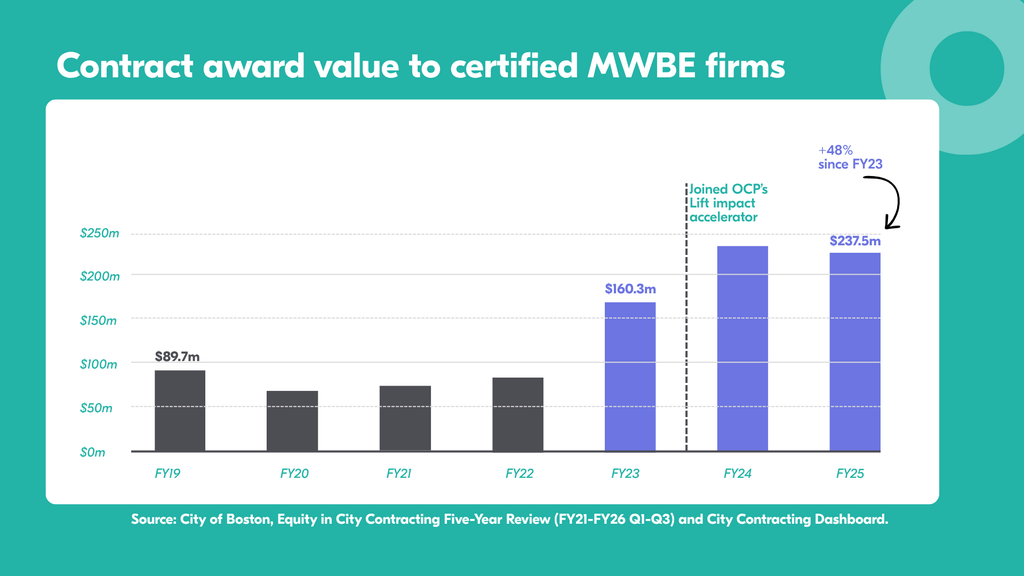
FY26 offers an early indication of how the reforms have continued beyond Lift. From July 2025 to June 2026, certified M/WBE firms received $133.7 million in spending, equal to 11.4% of the City total.
While award value to minority- and women-owned businesses has decreased somewhat in FY26 relative to the City’s overall procurement activity, discretionary spending to minority- and women-owned businesses remained steady in FY26, representing around 11-12% of the City’s discretionary spending each year from FY24-FY26.
Behind the contract figures are real workplaces. For small businesses, securing public procurement deals can mean hiring more workers, expanding operations and supporting the local economy by growing demand for professional services like accountants and lawyers. Between January 2024 and December 2025, 514 certified businesses received a City payment. Complete employment information was available for 238 of them. Based on those records and an extrapolation for firms without employee data, OCP estimates that the businesses employed more than 10,000 people.
The supplier base is growing too: 1,037 businesses held an active City certification in FY25.
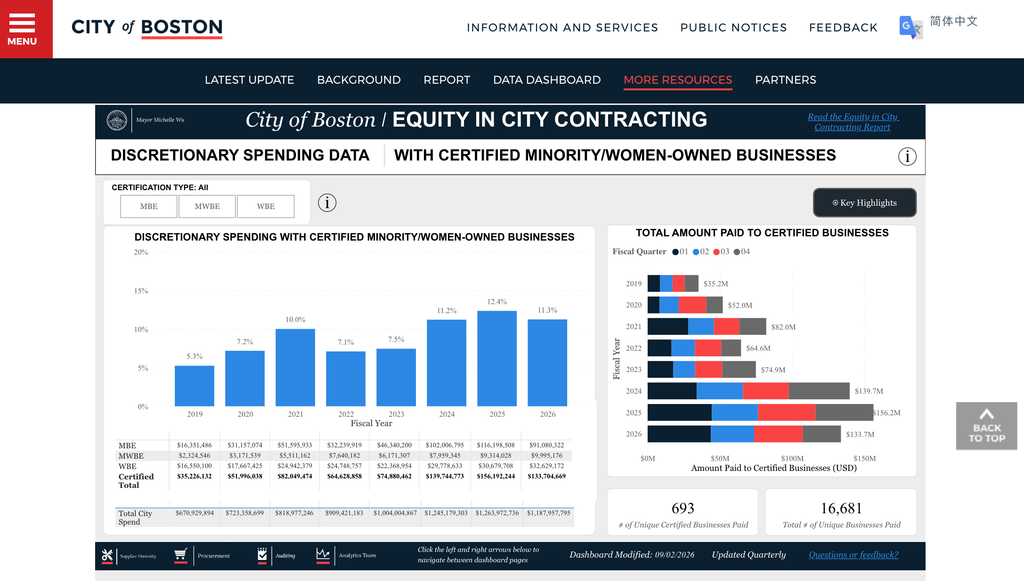
Boston can now examine where spending is going, which departments need support and where supplier-diversity policies are translating into contracts.
Passing it on: lessons for other cities
A disparity study can diagnose a problem. Data infrastructure and operating routines are what allow a city to solve it: a dashboard that buyers use, a planning cycle that departments update, shared definitions and procurement methods that translate policy into daily decisions.
Boston’s experience also shows that the work cannot sit with a single supplier diversity or data team. Procurement, finance, legal, auditing, analysts and buying departments all have to use the system.
Staff have also worked to keep the policy language tethered to something real, taking analysts on field trips to project sites, a park ribbon cutting among them, so the people running the numbers can see, occasionally, what the numbers are actually for.

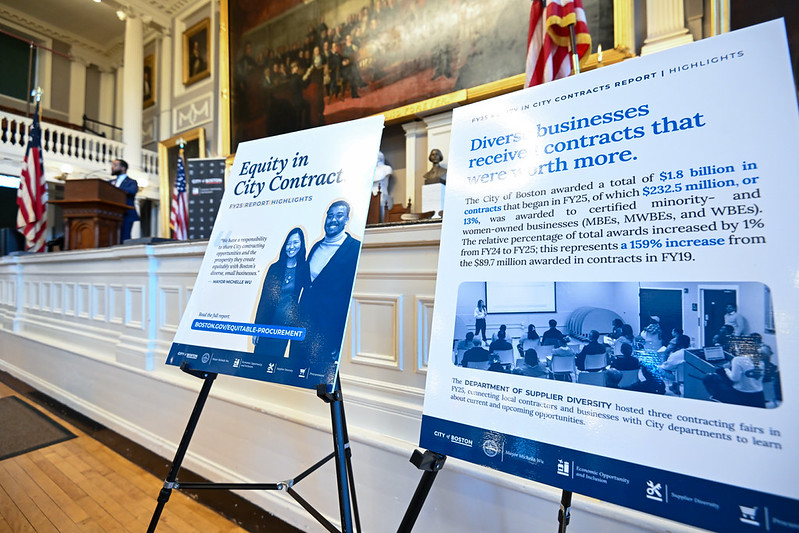
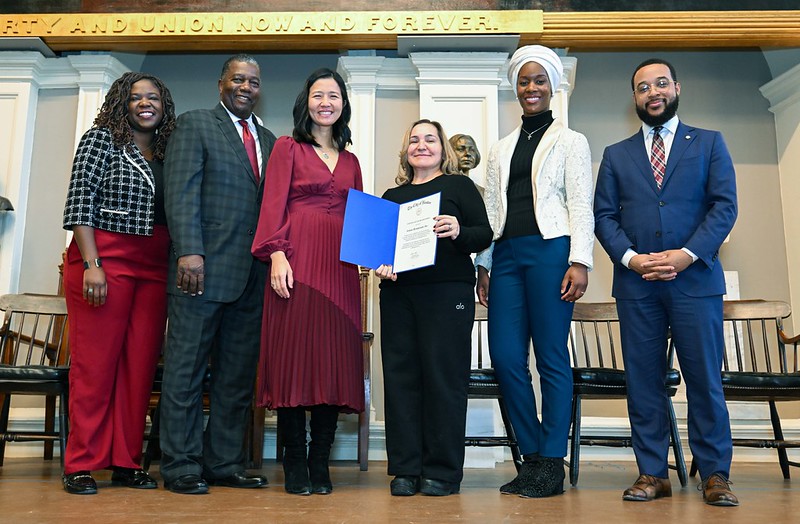
December 16, 2025, view of a full hall and Mayor Michelle Wu with graduates and city staff at the SCALE Program graduation ceremony. (Mayor’s Office Photo by Isabel Leon)
There is still more to do. Construction is Boston’s largest and one of its most complex areas of spending, while subcontracting remains difficult to measure.
Better tracking beneath prime contracts is the next test for Boston’s model: get clearer data, use it to identify where action is needed, engage the businesses affected and keep tracking whether the gap is closing.
For Laura Melle, the broader lesson is that procurement reform is “a double bottom line, not a zero-sum game”: opening opportunities to more businesses can also improve how the City buys. Her advice to other cities is simple:
“Make sure you have a seat at the table for policy conversations. That’s how you position procurement as a vital tool for achieving city priorities.”


