Connecting the dots: Beneficial ownership, asset declarations and political connections in public procurement

A company wins a major government contract. Its ownership information is publicly available. The officials responsible for awarding the contract have filed their asset declarations. The procurement process itself is documented. But can anyone actually connect the dots?
This is one of the central challenges in detecting corruption in public procurement. Political connections and conflicts of interest are often scattered across different datasets, institutions and corporate structures. Governments may collect much of the necessary information, but rarely connect it in ways that make systematic detection possible.
This year, we have been exploring how to change this by translating research on political connections in procurement into practical reforms that governments and civil society can use.
From disclosure to detection
Our work builds on research by Professor Mihály Fazekas of the Government Transparency Institute and Professor Marko Klasnja of Georgetown University, under the Governance & Integrity Anti-Corruption Evidence (GI-ACE) program, examining how political connections influence public procurement, particularly during crises and emergencies.
A particularly promising approach is to connect procurement records with two complementary sources of information:
- Beneficial ownership data, which reveals the natural persons who ultimately own or control companies competing for public contracts.
- Asset and interest declarations, which reveal the financial interests, business holdings and other relationships of public officials.
We also leveraged work by Professor Aaron Erlich of McGill University and his GDI project on standardizing asset disclosure data to demonstrate the potential of combining public procurement and asset disclosure data to identify suspicious relationships between suppliers and public officials. For example, a public official’s or their family member’s declared business interests may reveal a connection to a company winning government contracts that would never appear in procurement data alone.
But there is an important lesson: disclosure is not enough. Asset declarations need to be accessible, structured, comparable and linked to other datasets. Beneficial ownership information similarly needs to be verified, structured, and shared. And potential connections must trigger appropriate scrutiny.
The question is whether institutions are set up to share and use it, and work together toward a common goal.
Ecuador: Turning evidence into action
Ecuador provides an important opportunity to put these ideas into practice.
Working with the national procurement authority, SERCOP, and other government and civil society partners, OCP conducted a diagnostic of the country’s beneficial ownership and conflict-of-interest systems.
We found that Ecuador already has many building blocks: a national beneficial ownership registry managed by the tax authority (SRI), supplier ownership declarations collected by SERCOP, company registry information, and institutional capacity to analyze relationships between suppliers and public officials.
But important gaps remain.
The SRI holds the country’s most comprehensive beneficial ownership information, including ownership structures traced through to natural persons. Yet, despite having access, SERCOP does not currently use this registry as its primary source for validating supplier declarations (as it is required to use a different source of information. Information is fragmented across institutions, and different definitions and data formats make it difficult to connect records reliably.
SERCOP’s Risk Directorate has developed its own analytical capacity to investigate relationships between suppliers and public officials. However, these investigations are largely reactive, responding to specific requests rather than being conducted systematically across procurement processes. Mechanisms for tracking what happens after potential conflicts are referred to oversight and enforcement agencies are also limited.
Civil society faces similar challenges. Organizations such as FUNDAPI have demonstrated how procurement and ownership data can be combined to support independent monitoring, but access to consolidated, downloadable information remains limited.
Our recommendations focus on making better use of what already exists: connecting registries, improving data quality, strengthening institutional information-sharing, introducing more proactive risk analysis and making information more accessible to external monitors.
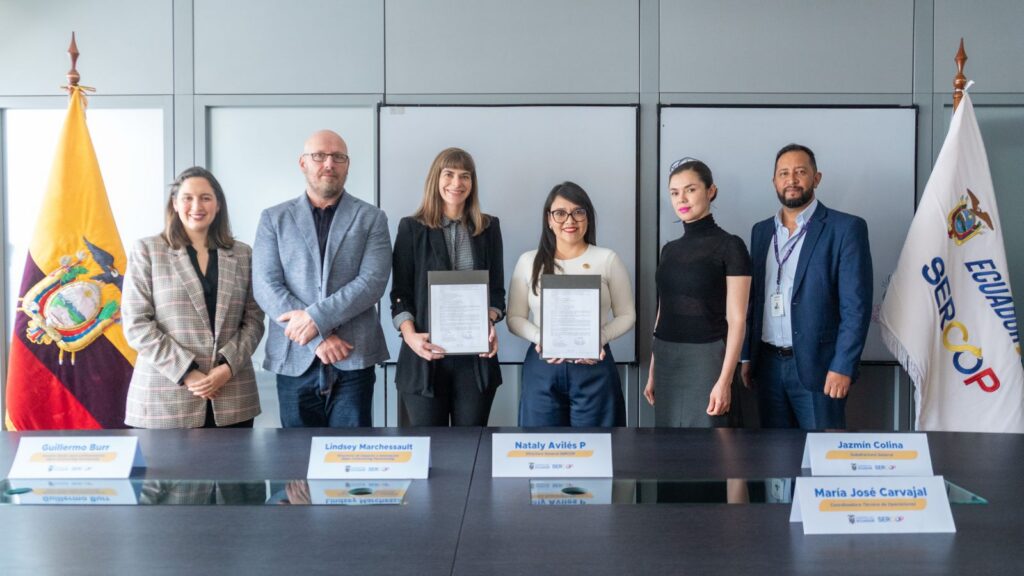
While in Ecuador earlier this month, we signed an MOU with SERCOP to continue improving their open contracting data, red-flag analytics, and conflicts of interest detection. The lessons we are learning are relevant to Ecuador’s ongoing IDB-funded e-procurement modernization and to other countries building links between beneficial ownership registers and procurement systems.
Building a bigger reform agenda
This work is part of a broader effort to make beneficial ownership transparency meaningful in public procurement.
We are also developing a Beneficial Ownership Transparency in Public Procurement Toolkit with the World Bank. The toolkit will help governments move from beneficial ownership disclosure requirements to practical implementation by connecting ownership information with procurement processes, data systems, and oversight mechanisms.
Our work also complements our ongoing partnership with UNODC, funded by the Government of Norway, to strengthen open contracting and procurement integrity. This partnership provides an important opportunity to take lessons from Ecuador and other country engagements to a wider group of governments, building practical approaches that can be adapted and scaled across different institutional contexts.
We see real potential to bring these strands together: research that identifies how political connections distort procurement, tools and guidance that help governments connect ownership and interest information, and long-term partnerships that support institutional adoption and reform.
Ultimately, we want to go beyond collecting more data or generating more red flags, connect the dots, and act on them. This requires strong inter-agency coordination and clear institutional responsibilities at each step of the risk mitigation process, so that public institutions can identify risks earlier, investigate potential conflicts of interest more effectively, and ensure that public contracts are awarded in the public interest.
Photos: SERCOP, Ecuador


