$17 mil millones de dólares y 19 millones de vidas: El impacto global de OCP en 2025 y nuestra hoja de ruta para 2026

¡Una década de OCP! El año pasado cumplimos diez años, pero tuvimos poco tiempo para celebrar: los cambios sin precedentes en el panorama global de políticas y financiación nos afectaron duramente, a nosotros y a muchos de nuestros socios, exigiendo decisiones difíciles y una rápida adaptación.
Sin embargo, la contratación pública no va a desaparecer: independientemente de la forma exacta del gobierno (centralizado o descentralizado) o su nivel de financiación, aún necesita adquirir bienes y servicios para funcionar de forma inteligente y eficaz. Desde la construcción de infraestructura hasta la prestación de servicios de salud y educación, la contratación pública es fundamental para que los estados conviertan sus políticas en resultados prácticos para las personas.
Al igual que otros, tuvimos que tomar decisiones difíciles para cumplir mejor nuestra misión en 2025. Nuestras ambiciones originales para el año se vieron afectadas, pero logramos importantes logros y aportamos valor a nuestra comunidad.
Pero no se fíen solo de nuestra palabra. A continuación, pueden leer cómo nuestra comunidad cree que nos fue el año pasado en nuestra encuesta comunitaria más grande hasta la fecha, y qué les gustaría que prioricemos en 2026.
Ustedes hablaron. Nosotros escuchamos. Y juntos, lo lograremos.
Somos diligentes en el seguimiento y la presentación de informes sobre nuestro impacto. A continuación, presentamos lo que esperábamos lograr en relación con algunos objetivos clave en 2025, en comparación con cómo lo hicimos.
| Objetivo | Ambición | Realidad |
| Puntos de prueba verificados del impacto y el progreso de los proyectos OCP. | 10 | 7 |
| Número de publicaciones OCDS (con un estándar que permita saber quién compró qué, a quién, cuándo y por cuánto). | Objetivo monitoreado | 52 (en comparación con 48 en 2024!) |
| Número de veces que ha mejorado la usabilidad de los datos de contratación abierta. | 10 | 12 |
| Número de nuevos usos efectivos de los datos de contratación abierta | 10 | 16 |
| Número de proyectos, programas y organizaciones que obtienen financiación ajena al OCP para trabajos de contratación abierta. | 16 | 8 |
Dado que muchos de nuestros socios y proyectos dependían de la financiación de USAID, que se redujo a principios de año, consideramos que lograr 7 de nuestras 10 historias de progreso e impacto objetivo fue un resultado sólido. Estas incluyen avances en Chile, Assam (India), Filipinas, Lituania, Brasil, Reino Unido y Portland (EE. UU).
Estimamos que nuestras intervenciones mejoraron el gasto en adquisiciones de aproximadamente 17.000 millones de dólares este año, lo que impactó positivamente a 19 millones de personas. Puede consultar nuestros objetivos completos y cómo los calculamos aquí.
También nos complace haber superado todos nuestros objetivos de datos este año y estamos entusiasmados con el total de 52 países con OCDS. En la lista incluimos los gobiernos nacionales de Brasil y Tanzania y la ciudad de Portland (Oregón), el primer gobierno de Estados Unidos en publicar OCDS.
El incumplimiento significativo de nuestro objetivo para proyectos, programas y organizaciones que reciben financiación ajena a OCP para trabajos de contratación abierta refleja el complejo panorama de financiación. Es algo que nos preocupa profundamente porque es importante para nosotros lograr una escala global, por lo que brindaremos aún más apoyo a los socios este año para volver a encaminarnos.
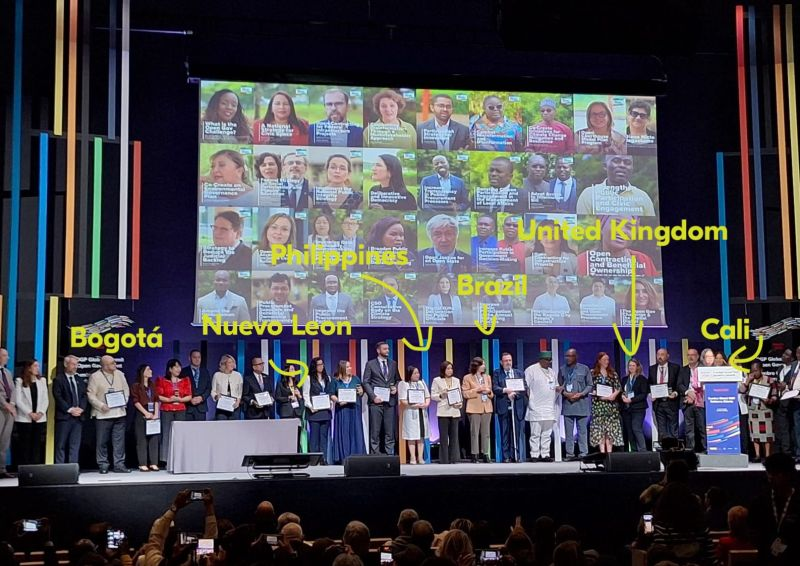
La Cumbre Global de la Alianza para el Gobierno Abierto (OGP) de 2025 nos recordó que el ecosistema de contratación abierta se mantiene resiliente: nuestros socios de Filipinas y el Reino Unido fueron reconocidos como ganadores del Premio OpenGov Challenge, y nuestros socios de Brasil, Nuevo León, México y las ciudades colombianas de Bogotá y Cali recibieron menciones honoríficas. ¡La energía y el entusiasmo de nuestra comunidad en eventos como la OGP nos impulsan hacia adelante!
Otro hito para nosotros en 2025 fue ver cómo el Ecosistema de Reconstrucción Digital DREAM de Ucrania se institucionalizaba como el sistema de Gestión de la Inversión Pública para todo el país. OCP gestiona la oficina de apoyo de DREAM, que coordina el proyecto, en estrecha colaboración con el gobierno ucraniano y numerosos actores cívicos y regionales. DREAM proporciona una única vía de proyectos, desde las comunidades hasta los financiadores, y ayuda a coordinar todas las etapas de preparación y ejecución de proyectos, impulsando una transparencia y rendición de cuentas sin precedentes para los cerca de 14.000 proyectos en desarrollo, con un valor total de 2,03 billones de UAH (aprox. 48.000 millones de dólares estadounidenses).
Análisis de la encuesta anual
Cada año preguntamos a nuestra comunidad qué estamos haciendo bien y qué podríamos mejorar. En 2025 tuvimos la mayor respuesta de nuestra historia. Agradecemos a los más de 325 miembros de nuestra comunidad en 63 países que participaron en la encuesta. Sus comentarios influirán en nuestro trabajo en los próximos años. Publicaremos un informe completo más adelante, pero aquí les presentamos algunos titulares:
- Ofrecimos un sólido apoyo a la programación y a nuestros socios en tiempos difíciles. Nos complace ver que nuestra programación y nuestro apoyo a nuestros socios se mantuvieron sólidos. Agradecemos seguir contando con una puntuación Net Promoter muy alta gracias a todos ustedes. Net Promoter es una medida común de satisfacción del cliente que se basa en la probabilidad de que nuestros socios recomienden trabajar con OCP. ¡Recibimos un 91 sobre 100, superando nuestra puntuación del año pasado! Además, preguntamos a nuestros socios si este año habían adquirido conocimientos, habilidades o estrategias de OCP que les ayudaran a generar cambios en la contratación pública y obtuvimos una puntuación media de 8,2 (8,7 para aquellos que interactuaron más estrechamente con OCP).
- Nuestros recursos siguen aportando valor. Al preguntarles: «¿Qué tan útiles les han resultado los recursos de OCP en general?», obtuvimos una puntuación media de 8 (8,4 para los socios con los que colaboramos más estrechamente). En cuanto a los recursos específicos que les resultaron más útiles, destacaron nuestra guía de documentación de OCDS (particularmente en África), nuestro sitio web, nuestro registro de datos y nuestros casos de progreso e impacto.
- La IA sigue siendo una prioridad. En cuanto a las áreas temáticas específicas sobre las que deseaban obtener más información, la IA siguió siendo la principal solicitud en la mayoría de las regiones, junto con nuestras áreas temáticas principales: anticorrupción (el tema principal en Asia), contratación electrónica e impacto verde/sostenible/social (una prioridad principal de nuestros socios globales). La IA también fue la solicitud más frecuente el año pasado, por eso creamos nuestro nuevo recurso «Comprando IA: Consejos y Herramientas para la Contratación Pública«, nuestro recurso mejor valorado en EE. UU.
- El desarrollo de habilidades en datos, la recaudación de fondos y el cambio de políticas son prioridades. De cara al futuro, nuestra comunidad está especialmente interesada en desarrollar habilidades y conocimientos sobre el uso y análisis de datos (en Asia, Europa del Este y Asia Central, Europa y Latinoamérica), identificar oportunidades de financiación en África y defender la contratación abierta, especialmente en EE. UU. y Canadá. Estas habilidades son nuestra base, por lo que estaremos encantados de ayudarte. Contáctanos.
Nuestros planes para 2026
En un año tan desafiante, ¡sus comentarios positivos y apoyo nos llenan de energía! Basándonos en sus comentarios, les presentamos nuestros planes para 2026.
1. Priorizar los impactos positivos en las personas. Nos entusiasman las oportunidades que ofrecen la IA y la digitalización (véase la prioridad 2), pero apoyar a nuestros socios nacionales con un cambio transformador y generar un impacto positivo en las personas es nuestra prioridad. La buena noticia es que observamos una amplia cartera de reformas innovadoras en materia de contratación pública en todo el mundo.
Nos entusiasma ver cómo los ganadores del premio al Desafío de Gobierno Abierto en materia de contratación pública cumplen con sus obligaciones para sus ciudadanos, y cómo los proyectos de transformación de eGP que apoyamos en países como Tanzania y Ruanda también cumplen con sus obligaciones, especialmente para las pequeñas empresas y los medios de vida locales. También, estamos iniciando dos nuevos proyectos importantes: uno en Europa para transformar la contratación pública verde en Polonia y otro en Estados Unidos para ayudar al estado de Colorado con una innovadora contratación modular de su sistema de prestaciones de la red de seguridad social. Como siempre, documentaremos el impacto y los desafíos a lo largo del proceso para apoyar el aprendizaje global. Así que, ¡el poder para el pueblo en 2026!
2. Ampliar nuestra oferta en torno a la IA. Por segundo año consecutivo, nuestros socios nos han expresado de forma abrumadora su deseo de que prioricemos más apoyo y formación en torno a la IA. El año pasado sentamos una base sólida con nuestra nueva guía de compra de IA, y nuestro equipo brindó asistencia tanto en la compra como en el uso de la IA en general, así como en su uso en las adquisiciones. Por lo tanto, creemos estar bien posicionados para hacer más en este ámbito. Por ejemplo, actualmente estamos probando un chatbot personalizado con tecnología LLM para apoyar a los usuarios en la organización y preparación de proyectos de infraestructura en DREAM (Ucrania), junto con otras mejoras de experiencia de usuario y ofertas de formación. También estamos entusiasmados con nuestro proyecto Medicamentos Transparencia con Transparencia Brasil, que utilizará la IA para inferir los precios unitarios de los medicamentos a partir de los datos de adquisiciones.
3. Cambiar las normas globales y ampliar las reformas. Nos entusiasman las nuevas colaboraciones que nos ayudarán a ampliar la contratación abierta en todo el mundo. Agradecemos al gobierno de Noruega y a la Oficina de las Naciones Unidas contra la Droga y el Delito (UNODC) que nuestra alianza global para impulsar la integridad en la contratación pública continúe y se amplíe en 2026. Nuestra colaboración con la Oficina de las Naciones Unidas de Servicios para Proyectos (UNOPS) está dando sus frutos, y nos complace ayudar a UNOPS con sus datos de contratación y a hacerlos más transparentes y accesibles. De cara al futuro, nos complace colaborar en la próxima revisión de la Recomendación sobre Contratación Pública de la OCDE para apoyar un seguimiento y monitoreo más basado en datos de los resultados de las contrataciones.
¿Cuál es tu visión para una mejor contratación pública para las personas y el planeta en 2026?
¡Contáctanos y cuéntanos cómo podemos ayudarte!